When it comes to home improvement, some dollars stretch more than others. And if you’re on a limited budget, it becomes even more important to spend those dollars wisely.
Here are seven affordable home improvement projects that’ll help you enjoy your home more today and provide excellent financial return in the future.
#1 Add the Finishing Touch of Molding Decorative molding in a home.
Wood moldings come in hundreds of options — from simple to ornate — that you can stain, paint, or leave natural.
You can also find moldings in flexible materials, such as foam, that make installation a whole lot easier. Some moldings even include lighting that casts a soft, ambient glow.
Buyers consistently rank both crown molding and chair railing in their list of most desirable decorative features they seek in a home (#3 and #7 respectively), according to the annual National Association of Home Builders (NAHB) survey, “What Home Buyers Really Want.”
And at $1.50 per foot if you DIY it, or $8 per foot if you hire, it’s a no-brainer in terms of personalizing your home while adding value. (Although we don’t recommend DIY unless you’ve got above-par mitering skills.)
A few tips about molding:
Use crown molding to make a room seem bigger and taller. But be careful about proportions. If your ceiling height is 9 feet or less, go with simpler styles to avoid overwhelming the room.
Place a chair railing at one-third the distance of the ceiling height. Chair railing placed incorrectly can make a room seem out of proportion.
Don’t forget entryways, doors, and windows: Bump up the trim around these areas to give rooms a completed and expensive feel.
#2 Install Quality Ceiling Fans Once ceiling fans were frowned upon — they were just a cheap solution to rising energy costs — ugly, wobbly, noisy eyesores endured because they were cheaper than air conditioning.
Not today!
If your ceiling fans are old and outdated, new ones (coupled with a fresh paint job and crown molding) could give your rooms a refreshing update while saving money.
Some tips about ceiling fans:
Hang 7 to 8 feet above the floor. If you’ve got a low ceiling, buy a hugger ceiling fan that’s flush-mounted. Go for the biggest Energy Star-rated fan that will fit the space. Choose quality. You’ll get better cooling results, less noise, and good looks at a digestible price point of $200 to $600.
#3 Plant Some Trees Apple tree outside of a house next to a patio.
Say what? Adding trees doesn’t instantly pop into your head when you think of adding value to your home. But trees are moneymakers that get better with age.
A mature tree could be worth between $1,000 to $10,000, says the Council of Tree and Landscape Appraisers. A 16-inch silver maple could be worth $2,562, according to a formula worked out by the Purdue University Cooperative Extension Service.
In urban areas, money really does grow on trees. A recent study of home sales by the Pacific Northwest Research Station of Portland showed that street trees growing in front of or near a house boosted its sale price by an average of $8,870 and shaved two days off its time on the market.
There’s more. Trees also:
Save $100 to $250 annually in energy costs Lower stress Prevent erosion from downpours and roof runoff Protect your home from wind, rain, and sun.
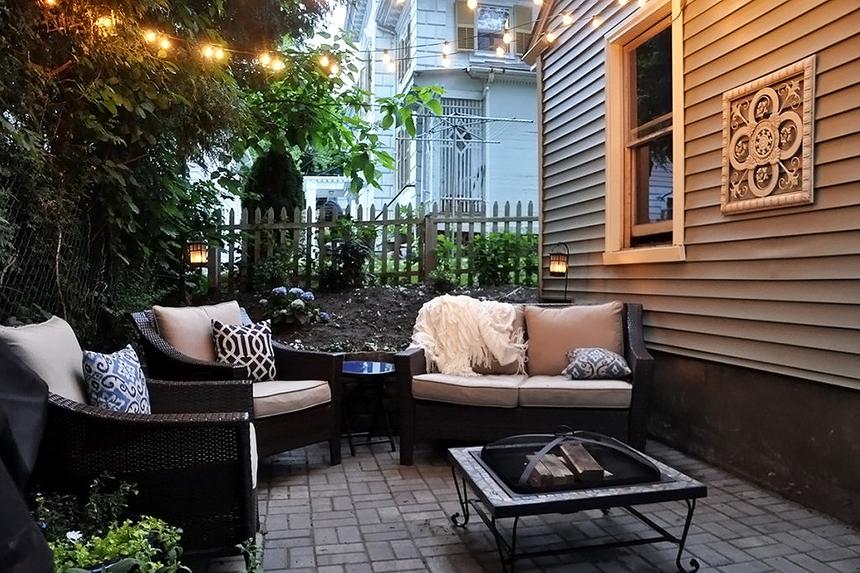
#4 Install a Patio Back yard patio in the dusk
A patio practically pays for itself, costing about $6,400 with a 102% return when you sell.
But don’t go crazy and trick out your patio with high-end amenities, like an outdoor kitchen — especially if you’d be the only one on the block with one. When it’s time to sell, you won’t get back much — if any — of your investment on outdoor kitchens and other high-end amenities. Instead, keep it simple and functional.
Some wise advice when planning a patio:
Check property for slope, sun, and shade patterns. Remember ‘dig alerts’ that utilities provide free of charge. Don’t skimp on patio lighting. It can make all the difference in functionality and beautification.
#5 Do Almost Any Energy-Efficient Upgrade The value of energy-efficient houses just keeps going up and up. A UCLA study examined the sales prices of 1.6 million California homes from 2007 to 2012 and found that homes with Energy Star, LEED, or GreenPoint certification had, on average, a 9% higher price.
That finding is echoed in NAHB’s report that surveyed homebuyers across the nation: Nine out of 10 potential buyers would select an efficient home with lower utility bills over a less efficient home priced 2% to 3% less.
One energy-saving home improvement project that not only saves energy but gives you tons of enjoyment, too, is converting a wood-burning fireplace into a gas one. If you like to crunch energy numbers, gas fireplaces have energy-efficient ratings as high as 77%, compared with wood-burning fireplaces that convert only 15% of wood’s energy into useful heat.
In fact, 39% of homebuyers say a gas fireplace is an essential or desirable feature of the next home they purchase. So when it comes time to sell your home, more than one-third of potential buyers will be looking for a gas fireplace.
In the meantime, it’ll be paying for itself in reduced heating costs.
Some tips for converting to gas:
A direct-vent gas insert most closely replicates the wood-burning experience at a cost of about $3,000 to $4,000, installed. If you don’t have an existing fireplace, you can install a direct-vent (vents directly outside so you don’t need a chimney) gas fireplace for about $5,000 (installed and finished).
#6 Add Some Creative Storage We don’t have to sell you on the value of storage and built-in organization. Since when have you heard someone complain about too much storage? Never, we bet.
Adding storage is a no-brainer, but it does take a little brainpower to find your home’s hidden storage.
Here are a few ways to think outside of the toy box:
Open drywall to create storage cubbies between your wall’s studs. Install platform storage that hangs from your garage ceiling. Even stairs can give you more storage. One clever mom repurposed an old chest of drawers and created storage within a basement staircase.
#7 Light Up the Outdoors Exterior lighting makes your home shine in the evening, accents features you like most about your house, and helps keep burglars away. A hard-wired lighting fixture can cost $150 to $250 to install. On the plus side, you could get a 50% return on your investment, says Judith Patriski, a Cleveland appraiser and REALTOR®. Installing motion-detecting lights can even lower some homeowners’ insurance premiums. (Check with your agent.)
And with technological advances in solar lighting, it’s easier and more cost-effective than ever to boost your home’s nighttime curb appeal.
Plus, 90% of buyers say outdoor lighting is on their list of desired home features.
Tips:
- Place accent lights under your favorite trees to show off your landscaping’s top earners.
- If your lights are hard-wired, put them on a timer so you don’t waste energy running them during the day.
- Choose a warm white light. It’ll make your home look and feel welcoming.